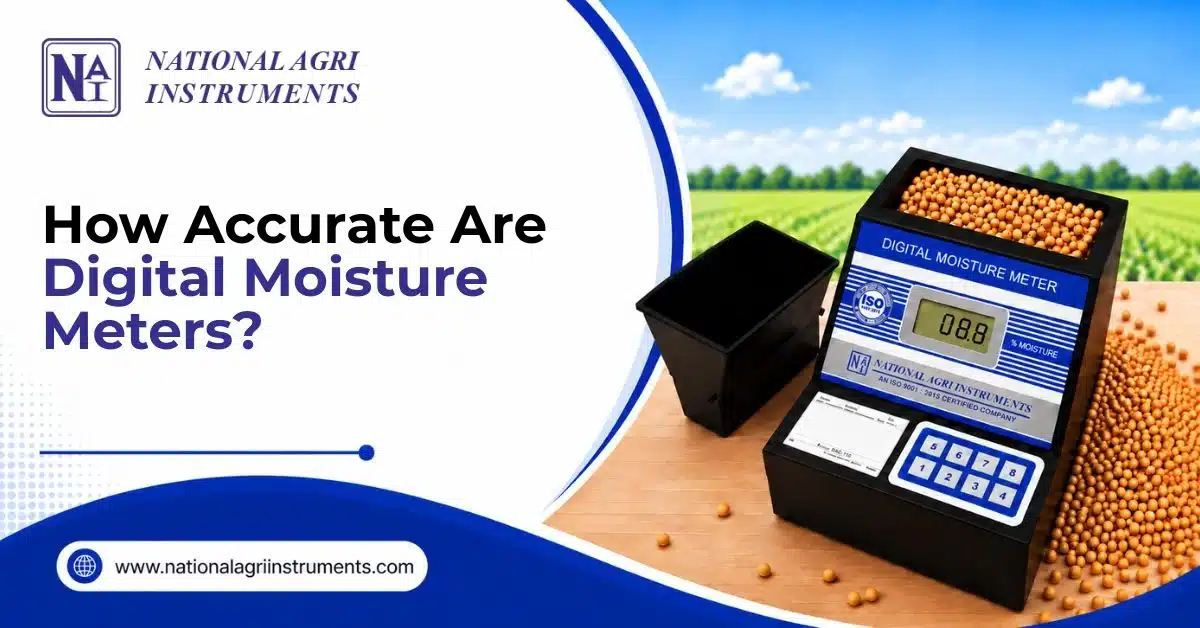
Moisture measurement is important when evaluating agricultural materials, grains, and other moisture-sensitive samples. But how…

Seed Moisture Meter: How It Helps in Seed Quality Testing?
Seed quality testing involves evaluating different characteristics that can affect how seeds are handled, stored, and maintained. Moisture content is one of the practical parameters to monitor because unsuitable moisture conditions can create challenges during storage and quality management. Using a Moisture Meter allows seed handlers and quality-control teams to measure moisture content rather than relying on appearance or handling characteristics alone.
Why Is Moisture Important in Seed Quality Testing?
Moisture content is an important consideration when evaluating seeds before storage. Excess moisture can create unfavorable storage conditions, while inconsistent moisture levels can make it more difficult to maintain uniform quality across a batch.
Regular moisture testing provides measurable information that can be compared between samples. A Moisture Meter therefore helps quality-control teams include moisture measurement as part of their routine seed evaluation process.
How Does a Moisture Meter Help Test Seed Samples?
Seed moisture testing requires a representative sample and consistent testing conditions. The sample is placed into the instrument, which measures its moisture content according to the instrument’s measurement method.
A Seed Moisture Meter can make this process more practical when moisture needs to be checked regularly across different samples or batches. NAI’s moisture meter uses an impedance-type measurement method and has a stated measuring range of 00.0% to 40.0% moisture.
How Can Moisture Testing Support Seed Storage?
Storage conditions can influence how seed quality is maintained over time. Monitoring moisture before storage can help users understand the condition of a sample and identify whether moisture levels are changing during storage.
Using a Moisture Meter at relevant stages provides measurable readings that can be recorded and compared. This can support more consistent moisture monitoring instead of depending only on visual inspection.
Need reliable moisture testing equipment? Contact us for your seed testing requirements.
Why Is Consistent Testing Important?
A moisture reading becomes more useful when testing conditions remain consistent. Differences in sample quantity, handling, temperature, or testing procedure can influence the comparability of results. Using a Moisture Meter under consistent testing conditions helps users obtain more comparable readings across different samples.
NAI’s moisture meter uses an approximate 250 cc sample size, and its reading starts settling at around 40 seconds after the sample is poured. Following a consistent procedure helps users compare readings from different samples more effectively.
Does Temperature Affect Seed Moisture Measurement?
Temperature is another factor that can influence moisture measurement. When samples are tested at different temperatures, the resulting readings may vary, making consistent testing more difficult.
A Moisture Meter with automatic temperature compensation can help address temperature-related variations. NAI’s instrument includes automatic inbuilt temperature compensation, supporting more consistent measurement when sample temperatures differ.
What Features Matter for Seed Moisture Testing?
When selecting equipment for seed quality testing, users should look beyond the moisture range alone. Important considerations include the measurement method, accuracy, sensitivity, temperature compensation, sample requirements, testing time, and ease of operation. A Moisture Meter with suitable specifications can make routine seed moisture testing more practical and consistent.
NAI’s moisture meter has a stated ±0.2% accuracy and ±0.1% sensitivity, along with a 3½-digit LCD and no mechanical moving parts. These specifications can be considered according to the requirements of the intended seed-testing application.
How Does Regular Moisture Testing Support Quality Control?
Regular testing can help establish a consistent approach to monitoring moisture across samples and batches. Recording readings over time can make it easier to identify changes and compare moisture conditions before and during storage.
A Moisture Meter supports this process by providing measurable moisture values that can become part of routine quality-control checks. The results can then be considered alongside the other quality parameters relevant to the seeds being evaluated.
Frequently Asked Questions
Why is moisture testing important for seed quality?
Moisture testing provides measurable information about the moisture condition of seeds, which can be useful when evaluating samples before and during storage.
How does a Moisture Meter help with seed testing?
It provides a moisture reading from a tested seed sample, allowing users to measure and compare moisture content across samples or batches.
Can temperature affect seed moisture readings?
Yes. Temperature differences can influence moisture measurements. Automatic temperature compensation can help support more consistent readings.
What moisture range does the NAI moisture meter measure?
The NAI moisture meter has a stated measuring range of 00.0% to 40.0% moisture.
How can seed moisture testing support quality control?
Regular measurements provide comparable moisture data that can be recorded and reviewed as part of a consistent seed quality-control process.
Conclusion
Moisture measurement is a useful part of seed quality testing because it provides measurable information about the moisture condition of a sample. A Moisture Meter can help users monitor this parameter consistently before storage and during quality evaluation. Selecting equipment with suitable accuracy, measurement range, temperature compensation, and practical sample handling can make routine seed moisture testing more effective.
Related Posts