Moisture measurement is important when evaluating agricultural materials, grains, and other moisture-sensitive samples. But how…
What Is a Moisture Meter and How Does It Work?
Moisture content can affect the quality, storage, handling, and processing of many materials. Measuring moisture accurately is therefore important for laboratories, agricultural businesses, processing units, exporters, and other organizations that regularly evaluate samples.
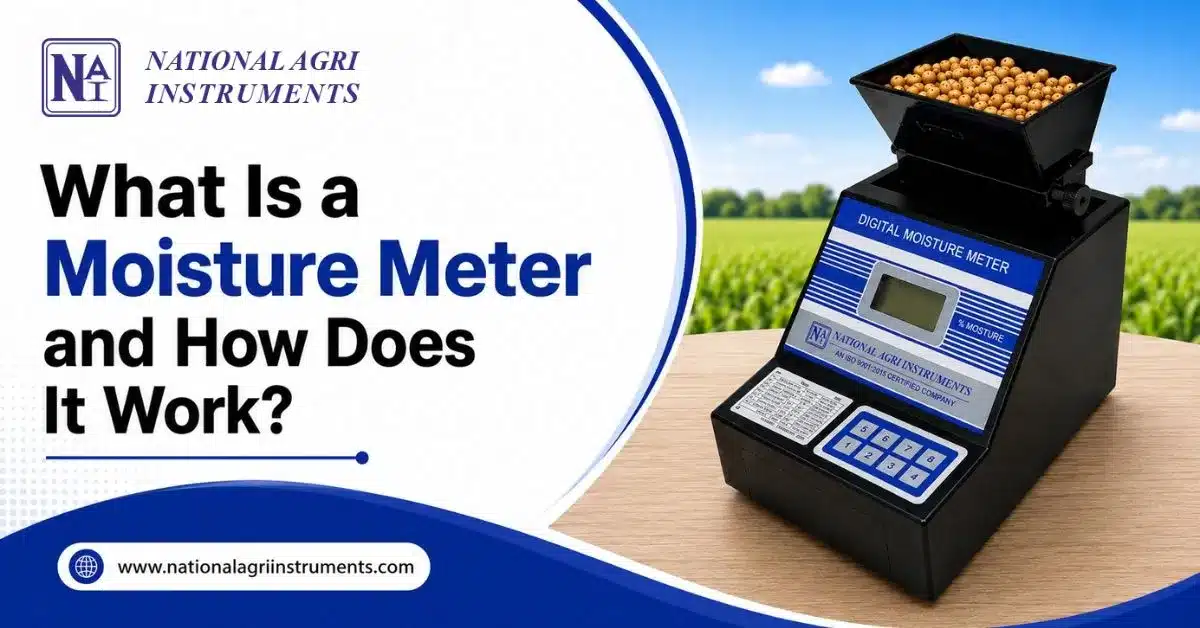
A Moisture Meter is an instrument designed to determine the moisture content of a sample through an electronic measurement process. It provides a direct reading, making moisture testing simpler and more consistent than relying on manual calculations or charts.
What Is a Moisture Meter?
A Moisture Meter is a testing instrument used to measure the amount of moisture present in a sample. It helps users determine moisture levels quickly and supports routine quality evaluation.
The instrument described by National Agri Instruments uses an impedance-type measurement principle. The sample is placed into the instrument, where its electrical characteristics are evaluated by the internal electronics to determine the moisture reading.
A Moisture Meter can be useful when users need to:
- Check moisture content in samples
- Perform routine quality testing
- Monitor moisture levels
- Support storage and processing decisions
- Obtain consistent measurement results
- Test samples without destructive procedures
How Does a Moisture Meter Work?
The working process of a Moisture Meter involves placing a prepared sample into the instrument and allowing its internal electronics to process the measurement.
The basic process includes the following steps:
- Sample Preparation: The sample is prepared according to the testing requirements. For the National Agri Instruments model, the specified sample size is approximately 250 C.C.
- Sample Pouring: The prepared sample is poured into the instrument. Once the sample is placed inside, the measurement process begins.
- Impedance-Based Measurement: The instrument uses an impedance-type measurement principle. Its internal electronics process the electrical characteristics associated with the sample to determine its moisture content.
- Automatic Temperature Compensation: Temperature can influence measurement conditions. The instrument includes automatic built-in temperature compensation, allowing the electronics to compensate automatically during testing.
- Moisture Reading: The resulting moisture value is shown directly on the 3½ LCD display, allowing the user to read the measurement without referring to charts or performing separate calculations.
What Is the Impedance Measurement Principle?
An impedance-type Moisture Meter uses the electrical characteristics of the sample as part of the moisture measurement process.
The National Agri Instruments instrument is based on this principle. The sample is introduced into the meter, and its internal electronic system processes the measurement before displaying the resulting moisture value.
This electronic approach provides a straightforward method for routine moisture testing.
Why Is Temperature Compensation Important?
Temperature can affect measurement conditions, which makes temperature compensation an important feature in moisture testing equipment.
The Moisture Meter provided by National Agri Instruments includes automatic built-in temperature compensation. This means the instrument’s internal electronics automatically compensate for temperature during measurement.
As a result, the user does not need to manually calculate or adjust temperature compensation during the testing process.
How Long Does a Moisture Meter Take to Measure a Sample?
Measurement time depends on the instrument and its testing procedure. According to the National Agri Instruments specifications, the instrument has a measurement rate of one sample per minute.
The product information also states that the reading starts settling approximately 40 seconds after the sample is poured.
This allows users to carry out regular sample testing without a lengthy measurement procedure.
Is Moisture Meter Testing Non-Destructive?
The National Agri Instruments Moisture Meter is specified for non-destructive sample testing.
Non-destructive testing allows the moisture content of a sample to be measured without damaging it through the measurement procedure. This can be useful when the sample needs to be retained after testing.
What Are the Key Features of a Moisture Meter?
When selecting a Moisture Meter, its measurement specifications and construction are important considerations.
The National Agri Instruments model offers:
- Measuring range of 0.0% to 40.0% moisture
- ±0.1% sensitivity
- ±0.2% accuracy
- 3½ LCD display
- Automatic built-in temperature compensation
- Approximately 250 C.C. sample size
- Measurement rate of one sample per minute
- Four pencil cells for power
- ABS molded body
- Non-destructive sample testing
- No mechanical moving parts
The display also provides a “LOBAT” / “BAT” indication when the pencil cells are weak.
Looking for a Reliable Moisture Meter? Contact Us today for product details and expert assistance.
What Are the Benefits of Using a Moisture Meter?
A Moisture Meter can make routine moisture testing more convenient by combining electronic measurement with direct digital display.
- Simple Testing Process: The instrument is designed to provide a straightforward testing process without requiring manual calculations or moisture charts.
- Automatic Temperature Compensation: Built-in temperature compensation simplifies testing by automatically accounting for temperature during measurement.
- Direct Reading: The 3½ LCD display provides a direct moisture reading, making the result easy to observe.
- Non-Destructive Testing: The instrument supports non-destructive sample testing, allowing the sample to remain available after measurement.
- Rugged Construction: The ABS molded body is designed for rugged use in field conditions and for longer service life.
- Reduced Mechanical Wear: The absence of mechanical moving parts helps avoid wear and tear associated with moving components.
Where Are Moisture Meters Used?
Moisture measurement can be relevant to organizations that regularly evaluate samples as part of their operations or quality procedures.
National Agri Instruments provides technical solutions to:
- Exporters
- Surveyors
- Laboratories
- Oil industries
- Government organizations
- Non-government organizations
- Rice industries
- Solvent plants
- Flour mills
- Wholesalers
- Brokers
- Commission agents
The appropriate application depends on the material being tested and the requirements of the testing process.
What Should You Consider When Choosing a Moisture Meter?
Selecting a Moisture Meter requires consideration of the measurement requirements and operating conditions.
- Measuring Range: The measurement range should match the moisture levels expected in the samples. The National Agri Instruments model has a range of 0.0% to 40.0% moisture.
- Accuracy: Accuracy is important when moisture readings are used for quality assessment. The specified accuracy is ±0.2%.
- Sensitivity: The instrument has a specified sensitivity of ±0.1%.
- Sample Size: The required sample quantity should be suitable for the testing process. The specified sample size is approximately 250 C.C.
- Temperature Compensation: Automatic temperature compensation can make the testing process simpler by eliminating manual temperature adjustments.
- Construction: For regular field use, a durable construction can be important. The instrument features an ABS molded body.
- Maintenance Requirements: A design without mechanical moving parts can reduce mechanical wear and associated maintenance requirements.
Why Choose National Agri Instruments?
National Agri Instruments is a manufacturer and exporter of Moisture Meters and focuses on providing quality products with prompt delivery schedules.
The company emphasizes continuous product improvement and customer satisfaction. It also provides technical solutions to exporters, surveyors, laboratories, industries, government and non-government organizations, and other users requiring moisture testing solutions.
National Agri Instruments is an ISO 9001:2015 certified company for quality management.
Frequently Asksed Questions
What is a Moisture Meter?
A Moisture Meter is an electronic testing instrument used to determine the moisture content of a sample. It provides a direct moisture reading for routine quality evaluation.
How does a Moisture Meter work?
The instrument uses an impedance-type measurement principle. A prepared sample is placed inside the meter, and its electrical characteristics are processed electronically to determine the moisture content.
What is the measuring range of the Moisture Meter?
The National Agri Instruments Moisture Meter has a measuring range of 0.0% to 40.0% moisture.
How accurate is a Moisture Meter?
The specified accuracy of the National Agri Instruments model is ±0.2%, with a sensitivity of ±0.1%.
Does the Moisture Meter have temperature compensation?
Yes. The instrument features automatic built-in temperature compensation, which reduces the need for manual temperature adjustments during testing.
Conclusion
A Moisture Meter is an electronic instrument used to determine the moisture content of a sample. Its working process involves introducing a prepared sample into the instrument, measuring its electrical characteristics through an impedance-based system, compensating automatically for temperature, and displaying the resulting moisture value.
The National Agri Instruments model provides a 0.0% to 40.0% moisture measuring range, ±0.1% sensitivity, ±0.2% accuracy, automatic temperature compensation, and non-destructive sample testing. Its straightforward operation and direct LCD reading make it suitable for routine moisture measurement where consistent sample testing is required.
Related Posts